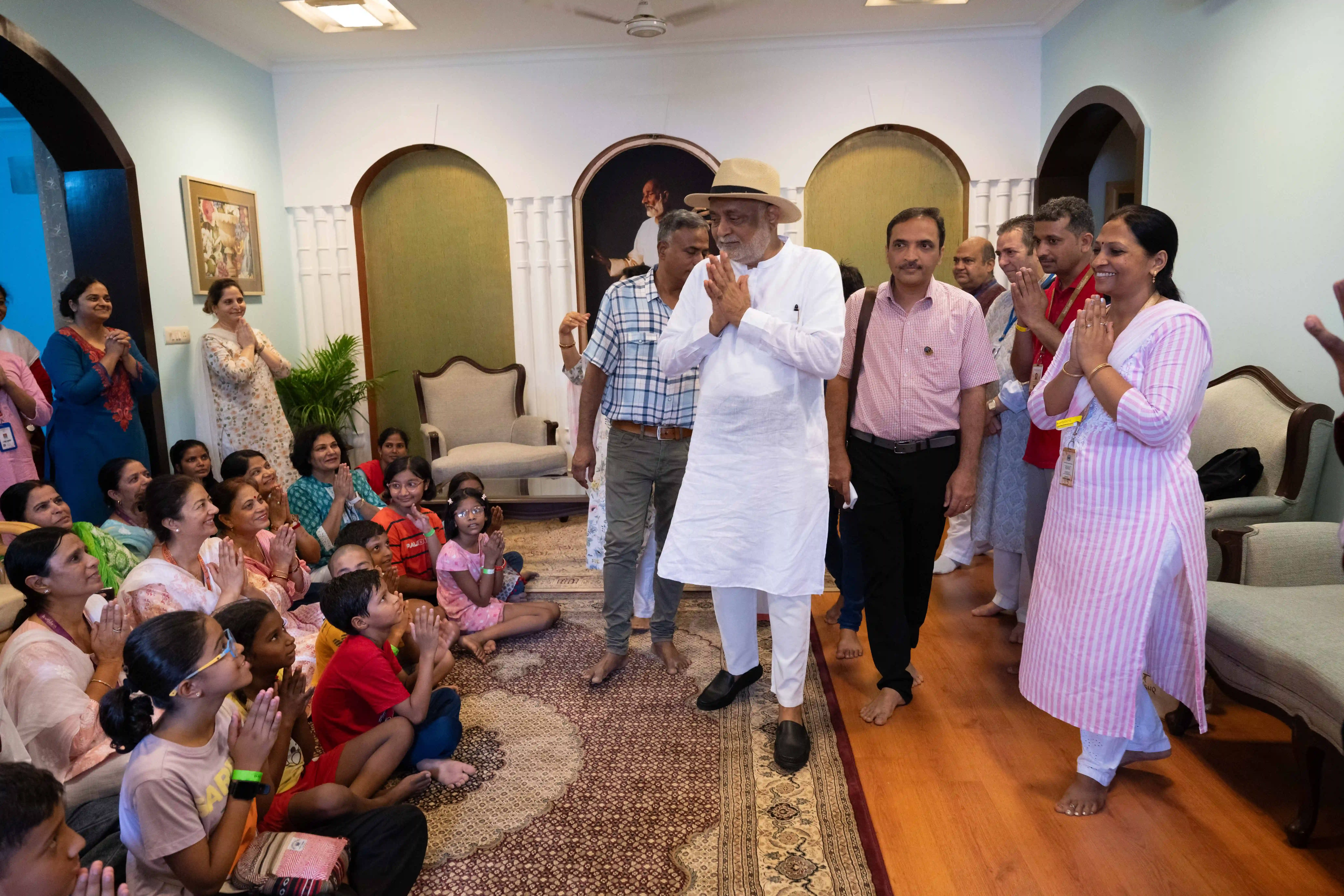
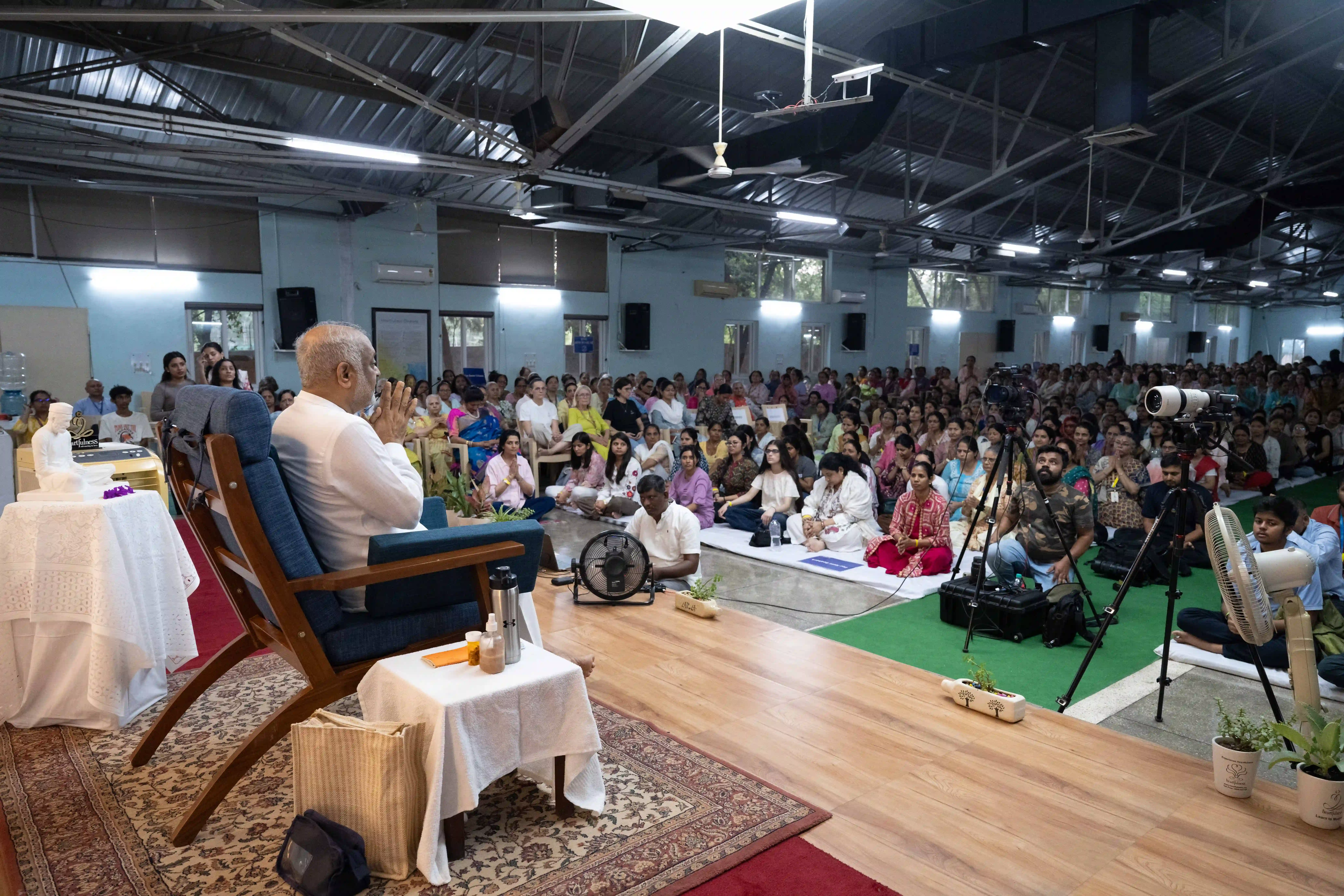
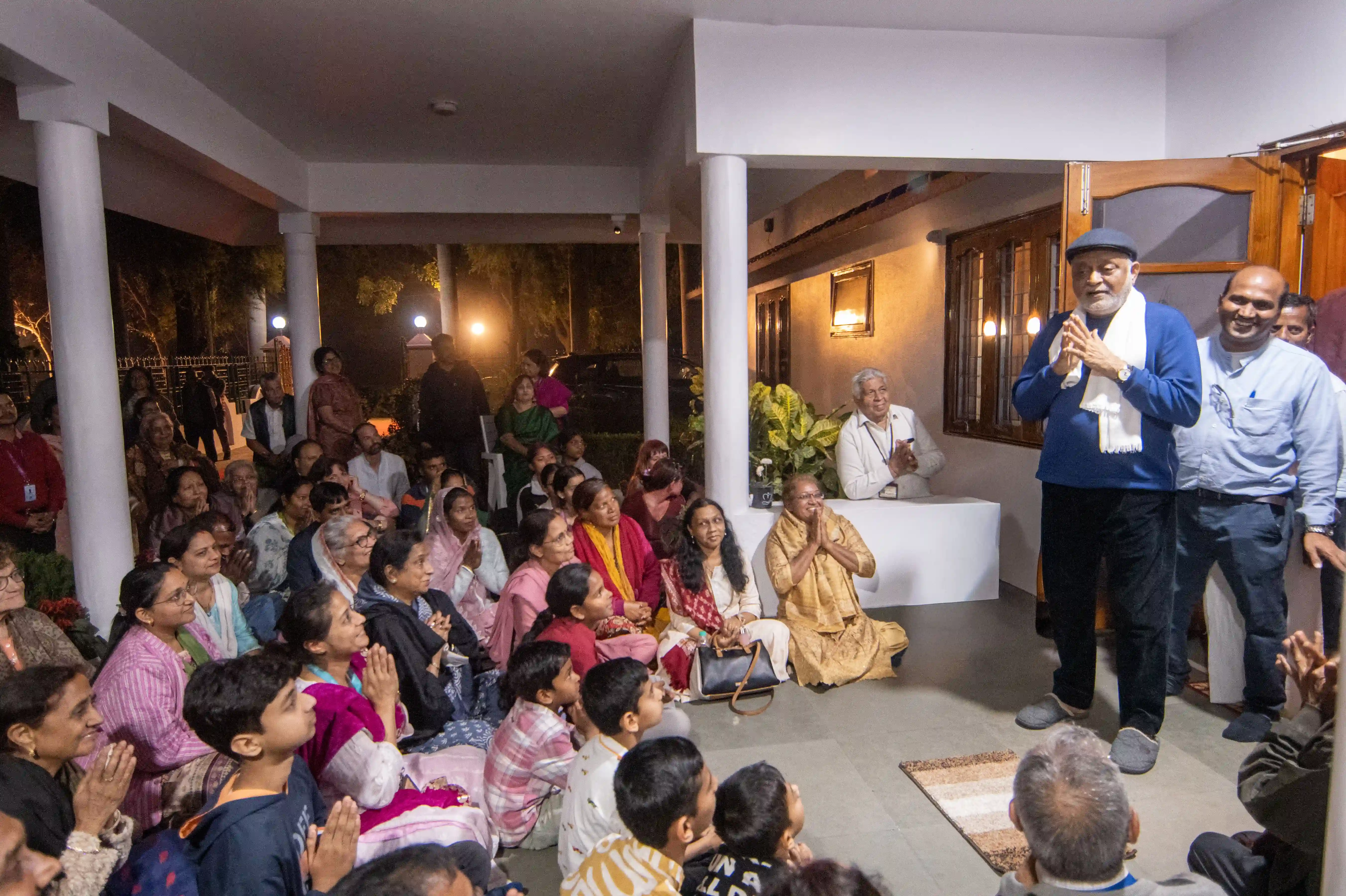
69th birthday of Pujya Daaji_batch2
Below are messages to download, read, and contemplate. The Journey After the Merger: When Water Forgets It Was Hydrogen Dear friends, A fundamental principle woven into the fabric of any spiritual pursuit is the cultivation of saranagati—a profound state of surrender and trust. It stands as the quintessential essence, a treasured core that guides us toward the sublime terrain of enlightenment and inner peace. Embracing saranagati is akin to opening ourselves to the universal flow, where the relinquishing of ego-driven resistance allows for a harmonious alignment with the greater cosmic will. Far from being a passive resignation, spiritual surrender is an active engagement in the divine tapestry; an alignment with the transcendent truths that underpin our existence. It is in this sacred surrender that the seeker finds true strength and an unshakable serenity that pervades all aspects of being. During this celebration for the 125th Birth Anniversary of Pujya Babuji Maharaj, I wish that we will all develop a positive longing for such a state of saranagati, loosely translated as surrender. Surrender is not always easy; we often resist. We may understand its importance on our spiritual journey in theory, but the resistance happens in practice. When faced with the opportunity to submit to the “other,” yield with supplicancy, and let go of our tendencies and beliefs, we struggle. Why is it so? Given that surrender is essential to reach our spiritual goal, what causes the resistance? Actually, it’s very understandable: not only is surrender a perceived threat to our freedom and free will, but it’s a threat to the very survival of an important part of us. That part is our sense of identity, the ego. The ego attaches itself to various qualities, attributes, and personality traits that become fixed over time, forming knots in our subtle bodies. Our subconscious programming and neural networks also become hardwired, and we develop tendencies and beliefs with which we identify. All this plays out at the subconscious level, tethering the soul, so is it any wonder we struggle? The unraveling of these knots is at the center of our spiritual journey, and the Master’s role is pivotal. The ego in its pure form is not the problem; rather, the attachments the ego forms to create its identity in the outside world are the problem, and this we know as egotism. Pujya Babuji Maharaj once said, “In my opinion, the mind and the ego are the only two things in man, the best and the most useful. In fact, ego refers to the real Being, and mind searches it out. Really we have to learn the proper utilization of everything in man. There must not be misuse of anything. That is humanity in the true sense, which is our human duty.” In Heartfulness,we learn to utilize the mind and the ego for our spiritual progress, through a combination of spiritual practices and lifestyle changes. What is the antidote to egotism? The simple answer is love. When we are in love, we happily surrender to our beloved, whether the beloved is a person or God. No effort is required. When we are in love, surrender is not only natural but can be genuinely beautiful. It brings harmony, a positive “yes” mentality, and an open expansiveness of heart. Have you observed a mother with her newborn baby, or a young couple in love? There is total surrender in feeling, attitude, and behavior, with no thought for themselves, only for the other because the ego has become so subtle, in its pure form. For a tree to be born, the seed must disappear. For a realized soul to be born, the “I” must disappear. We are approaching the subtle state where we do not impose anything on anyone. Instead, things simply happen around us. We have all experienced that state. We were once unborn babies, totally innocent and surrendered to our mother’s love and care. Our mother gave birth to us into this world and cared for us to grow and eventually become self-sufficient. The Master has a similar role. We are unborn spiritually, and when we surrender to his love and care, he births us into spiritual dimensions. For that evolution to happen, surrender is essential. Babuji also tells us, “The first step of self-surrender is discipline.” Discipline and surrender are two sides of a coin, as are surrender and acceptance. The final step of self-surrender is the state of self-negation. How to create love in our heart, discipline in our being, and acceptance in our attitude? Pujya Babuji Maharaj gives us the simplest way to create love in our hearts. Maxim Two of his Ten Maxims says, “Begin your meditation with a prayer for spiritual elevation. Offer your prayer in such a way that the heart is filled with love.” In the commentary on Maxim Two, he explains the science of prayer, of filling the heart with love—creating a vacuum so that the Divine Grace flows in. He invites us to do this twice a day, before morning meditation and before sleeping at night. The words of the Heartfulness Prayer also help us to develop that yielding vacuumized heart. The prayer is optimized for surrender if we take the time to fill our hearts with love in the way Babuji suggests. Love leads to surrender For that evolution to happen, surrender is essential. Babuji also tells us, “The first step of self-surrender is discipline.” Discipline and surrender are two sides of a coin, as are surrender and acceptance. The final step of self-surrender is the state of self-negation. and surrender leads to love. In that beautiful positive feedback loop we soar above the mundane existence into the realm of universal love and universal consciousness. Babuji’s Ten Maxims lay before us those secrets that were formerly passed down from heart to heart by spiritual masters to disciples, guiding us how to create love, how to become disciplined, and how to refine our attitudes. From how we practice to how we adapt to daily challenges and manage resources, he offers us a complete map to navigate life. Babuji doesn’t just advise us to surrender; he shows us how, easily, without mental strain, and supports the process with yogic Transmission Total acceptance of all existence Babuji also observes that the willingness to submit to the will of the Master is only the beginning of surrender. There is much more to come. For a realized soul, surrender is the total acceptance of all existence. At the other end of the spectrum, for an ignorant soul there is always some restlessness backed by rebelliousness. Challenges present themselves, injustices, hurts, and emotional hurdles. A stance is often made that “I am right, I know, and my position must prevail,” or “Why would that person betray me? How cruel!” Does surrender make us feel vulnerable? Yes! Does it take us out of our comfort zone? Yes! But then so do the challenges the ego throws up. Is it any better staying in the ego’s domain? No, it is simply that we are used to it, and we feel somehow justified in our beliefs and attitudes. The evolving nature of our spiritual yatra is to remove all that. Saranagati develops internally along with the yatra, little by little as layers of impurities and complexities are dissolved, first from the five chakras of the Heart Region, and then from each successive chakra in the Mind Region. This takes courage, an attribute that is strengthened at Chakra 4, so the process of accepting, yielding, becoming humble and insignificant is easier once Chakra 4 is awakened. Thankfully, this happens before we continue our journey through the Mind Region, where the rings of ego confront us with every attachment our ego has accumulated, one after another. But it is not until we arrive at the critical juncture of Chakra 9 that we find the true blossoming of surrender. Here we develop complete dependency on the Master, and no longer crave anything either of this world or of the next. It becomes incumbent upon the Master to resolutely exert himself and take us further. As we journey further into the Mind Region, the burden of ego dissipates, leaving us free to soar higher and higher, allowing consciousness to expand limitlessly. The energy that was contracted and suppressed finds expression, so we feel completely at peace with ourselves, and we find bliss within. Yet the unfolding journey is also why we sometimes feel uncomfortable with the process of surrender. At every chakra and subpoint, as the knots are loosened by the Master, the ego attachments are dissolved one after another. Surrender happens to us not by us through this process, and there will always be some level of friction associated with the unraveling. It is how we respond to the friction that matters: do we accept it as a bitter tonic for our well-being, or do we react? In addition, various stages along the journey are associated with letting go of all that happens during meditation, both arriving and transcending at the same time. Otherwise spending more time at any given state than needed will delay our journey. Going inward is the only way we can become surrendered; it is an inner attitude. Acceptance means surrendering to the entire existence—those things we like and those we don’t like. In fact, we move beyond the feeling of likes and dislikes, which means we move beyond the dualities of worldly life, beyond the Heart Region. We become moderate, neutral, balanced, and still within. Only then are our decisions likely to be truly accurate. There is no longer a selective process of acceptance and surrender. Surrender is therefore the result of our endeavors in the spiritual arena under the guidance of a capable Master, not an individual or group effort. Egotism leads to contraction of the self, while evolution leads to expansion of the self, letting go of the ego’s attachments. There is a play between contraction and expansion; between “I” and “Thou.” This plays out as we journey through the Mind Region. With expansion we find genuine happiness, while with ego-driven contraction we find misery. Eventually, as surrender takes hold and expansion predominates, we experience a shift in the quality of our consciousness. It is helpful to note that our identity is the creation of our individual soul; the rest is God’s creation. So, the only thing we can truly surrender to God is the ego. In its lowest form, it expresses as self-enhancement, narcissism, arrogance, dominance, stubbornness, rigidity in beliefs and attitudes, and mental imbalances like anxiety and depression. It is also associated with superiority and the fear associated with self-preservation. So the more surrendered we become, the more such qualities and characteristics vanish As we journey further into the Mind Region, the burden of ego dissipates, leaving us free to soar higher and higher, allowing consciousness to expand limitlessly. The energy that was contracted and suppressed finds expression, so we feel completely at peace with ourselves, and we find bliss within. And a third problem is constant curiosity and the impatience to always need to know. We will explore the ways these facets restrict surrender another tim. From selfishness to selflessness, from karma to akarma In the Bhagavad Gita, Lord Krishna spoke to Arjuna about surrendering the fruits of all his actions to the Divine with dedication and devotion. If we follow his advice, that intention leads to selfless action and the dissolving of any egotism around the things we think, say, or do. The result is skill in action. But even more life-changing than selfless action is the fact that all our actions develop the fragrance of love. Karma becomes akarma. Bhakti is infused into every element of karma. It flows through every atom of our being. For example, we all know the difference between food cooked with a mother’s love and food cooked by a person under compulsion. Love makes all the difference. In true surrender, every little thing is done with love. Actually, in true surrender, even love is transcended Yielding to the Master is just the beginning Christ said, “No one shall pass except through me to my Father and reach my Father.” Lord Krishna said, “Surrender to me, I will lead you over there.” In Buddhism, there is “Buddham Saranam Gacchami,” meaning “I take refuge in the Buddha.” When we listen to such statements they superficially appear quite arrogant. But think of it from the perspective of the relationship between a father and son, where the father lovingly says, “Please do what I say.” The same is true of a mother. The intention is to offer welfare with love and innocence. Only when the innocence of Lord Jesus matched with the innocence of his followers did the alchemy happen. Instead, when the response is, “Why must I surrender? Why must I go only through him?” it cannot happen. Why must they surrender? Because love means surrender. Not in the form of defeat, but in the evolutionary sense of transcending the individual ego, so our identity shifts from “I” to merge with “Thou.” Lalaji Maharaj spoke of this as the first stage of absorption, fana, which he describes as “being completely oblivious of the self, and the withdrawal of attention from the sense organs. Such a withdrawal is akin to the condition of death. The difference between this state and death is that in death there is nothing, no presence of anything before the dead, but fana is the State of Presence. This means that there is such a state of oblivion that the seeker becomes completely absorbed in the One, the Goal, and for the rest he becomes like a dead person. This is the State of Presence.” And Babuji wrote in a letter, “One abhyasi has observed and reported that she neither feels faith in Master nor love. More and more one feels this condition as one drowns in the condition of mergence. At the last, ‘it is what it is’ remains. She has gone beyond the condition of fana-e-fana [the spiritual condition of ‘death of death’] and is in the condition of Baqa [everlasting existence in God]. This Baqa should also be merged, and the chain continues further So surrender is an ever-unfolding process, and yielding to the Master is just the beginning. Awareness Surrender is of value when it happens with pure awareness, whereas surrender with unawareness is like giving an IV injection of prasad to a comatose patient. There is a wonderful couplet by the Indo-Persian Sufi, Amir Khusrau (1253-1325): खुुसरोो दरि याा प्रेेम काा, वााकीी उल्टीी धाार । जोो उबराा सोो डूू ब गयाा, जोो डूूबाा सोो पाार ॥ Khusrau dariya prem ka vaki ulti dhaar. Jo ubra so doob gaya jo dooba so par. Oh Khusrau, the ocean of love is inverse in nature. The one who swims, drowns, and the one who drowns gets to shore. And another by Kabir Saheb: जब मैंं थाा तब हरि नहींं� अब हरि हैै मैंं नााहींं� । प्रेेम गलीी अति सांं�करीी जाामेंं दोो न समााहींं� ॥ Jab mein tha tab hari nahin, ab hari hai mein nahin. Prem gali ati sankari, jame do na samahin. 16 of 20 When I see myself, God is not there; now I see God, I am not there. The pathway of love is narrow and two cannot co-exist. They both express the reality that complete saranagati involves a total eclipse of both the heart and mind. Yet awareness is still there as the soul is our witness: atman is dissolved into the ocean of Brahman, yet there is still awareness within universal consciousness. The paradox of surrender and free will Going back to our starting point, surrender creates fear and resistance in most of us. It is just like being unprepared for a test—we naturally develop fear. In the test of life, when we have done everything well, where is the need for fear? Acceptance and surrender will arise naturally. Yet, even when we are prepared, if there is no craving for the state of saranagati it will not happen. And surrender is also only possible when we consider ourselves to be insignificant servants of the Lord. We need both will and surrender on our journey to achieve the highest. This may seem confusing and paradoxical, yet Babuji reminds us that surrender and will are complementary, not contradictory, in Whispers from The Brighter World. 17 of 20 How to arrive at both? Babuji tells us in Reality at Dawn that: “Self-surrender is nothing but a state of complete resignation to the will of the Master, with total disregard of the self. A permanent stay in this condition leads to the beginning of the state of negation. “When we surrender ourselves to the great Master, we begin to attract a constant flow of the highest Divine force from Him. In this state a man thinks or does only that which is his Master’s will. He feels nothing in the world to be his belongings but everything as a sacred trust from the Master, and he does everything thinking it to be his Master’s bidding. His will becomes completely subservient to the will of the Master.” The shift is in our identity, the ego. When the ego identifies with God and the Master, our will starts to align with his. First it aligns with the Master’s will, and then it is subsumed in the Master’s will. This is possible when we have complete faith that God is protecting us at all times. So, observe yourself—your thoughts, actions, and reactions. If you want something but your Master wants something else, it is a diagnostic symptom that you are yet to surrender. If you are reactive to another person’s views or behavior, it is also a symptom that you are yet to surrender. I am not saying that you have to agree with them, but do you respond from a surrendered, neutral position of open listening and acceptance, or are you always ready to challenge? 18 of 20 The 4 Ss We can develop faith, humility, attract grace, and develop contentment by following the 4Ss: 1. Sadhana—spiritual practice 2. Smaranam—constant remembrance 3. Satsangh—spiritual assembly; being with Reality 4. Shastras—holy texts In a message from the Whispers received on Wednesday, February 19, 2014, at 10 a.m., Babuji says, “Everyone is helped according to their call and degree of surrender to the higher powers, as well as to the Master they have chosen to help them progress.” We can express this mathematically as Available help ∝ degree of surrender There is a hint in this equation that surrender saves us valuable time; we are helped according to our degree of surrender. Our way prescribes surrender. Transmission and all the Heartfulness practices support it. We start to identify with the highest, giving us a different perspective on life. As a result, we are willing to release our strong attachments to this world, most of which are anyway complexities of our own creation. Perfect negation Babuji tells us that the purpose of our existence is perfect negation, which begins when saranagati is at its pinnacle. As he suggests, “Destroy your creation, and His creation comes into being. ” 30th April 2024, Kanha Shanti Vanam Message given by Daaji on the occasion of the 125th birth anniversary of Pujya Babuji Maharaj Ask yourself: Is God-Realization possible without negation? Is the beginning of negation possible without surrender? Is surrender possible without acceptance? Is acceptance possible without love? Is love possible without resonance between two beings? Is resonance possible without mutual adoration? Is adoration possible without experience? Is experience possible without practice? The answer to all these questions is of course “no.” So, it all starts with practice—the simple Heartfulness methods of meditation with Transmission, cleaning, and prayer. At every stage of our journey, the same methods keep us moving forward, just as water, sun, and fertilizer are required at every stage of the growth of a tree, from seed to sapling to a mature tree. With love and respect, Kamlesh