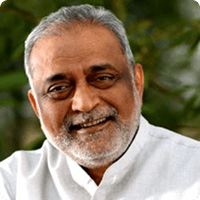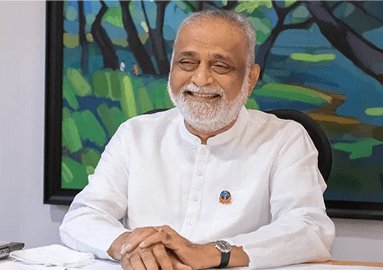

Spiritual guide and author of transformative works on meditation and consciousness

Global teacher inspiring millions through Heartfulness meditation practices

Advocate for inner transformation and the development of human potential

Expanded Heartfulness into a global movement inspiring millions across continents


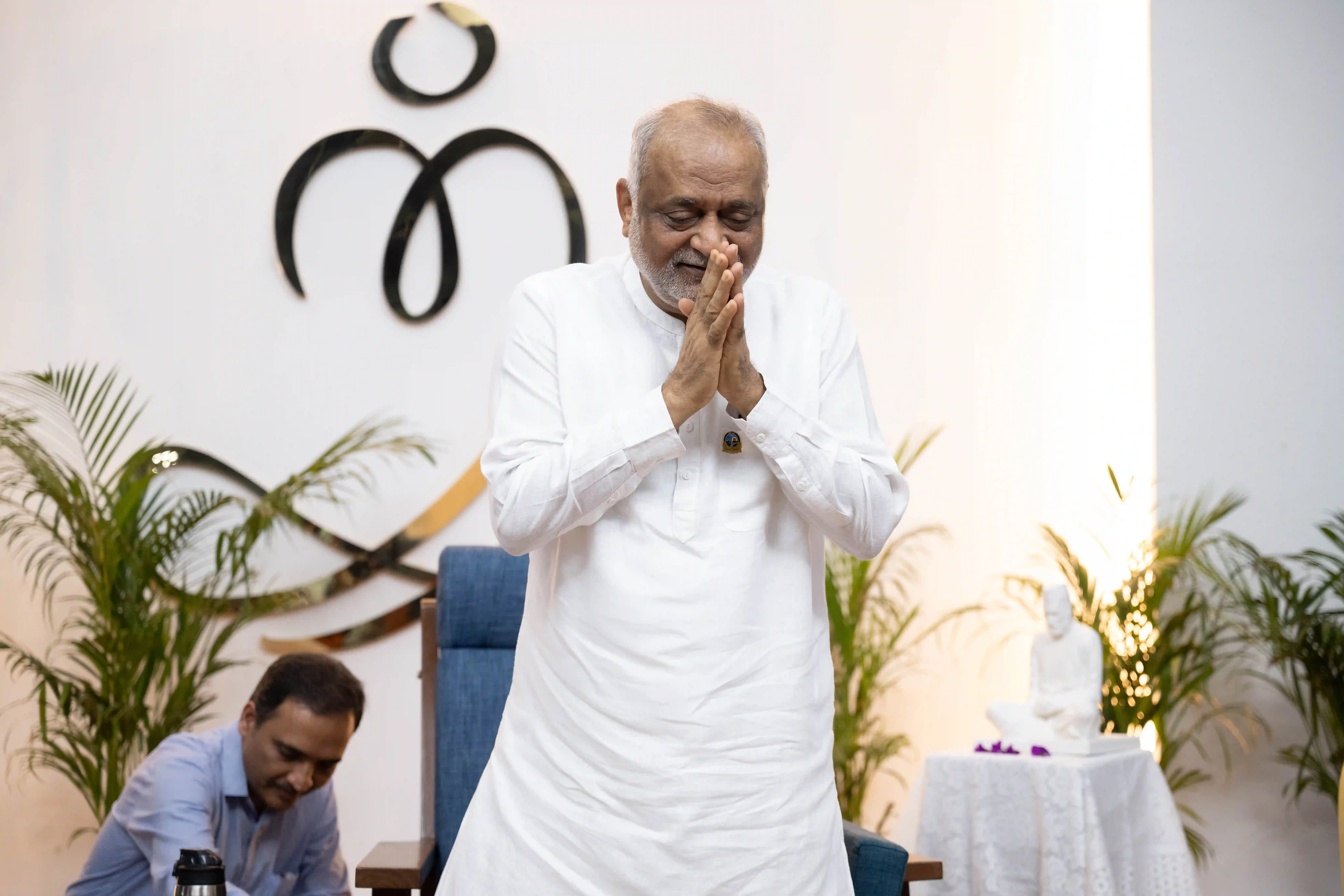
Daaji said, “Spiritual success is something else—the more you lose, the better you become. The more you lose, the greater the success within you. It’s a paradoxical understanding. So, we must be able to integrate the material world (where we seek more and more of ‘more and more’) and the spiritual realm (where we seek less and less of ‘less and less’ or we seek more and more of ‘less and less’). And when you are able to integrate these, only then you can confidently say when you're breathing your last, that ‘now I am able to leave this world contentedly.’ Because, when you are successful in the material world while you're alive, you will feel happy, but when that final moment [of death] comes, you will say ‘Sigh! I have not been able to do anything all my life.”
One sister asked Daaji what one should do when there is no support from the family and it becomes difficult to practise. In response, Daaji gave the example of his preceptor, Draupadi Devi Agarwal, from whom he had taken his very first sitting. He explained how she would pretend to be asleep early in the morning and meditate while lying under the quilt, and in the evening, under the pretext of going to the toilet, she would do her evening cleaning there. Daaji said matter-of-factly, “ Jisko karna hai, usko kaun rokega ? (If someone truly wants to do it, who can stop them?).”
Daaji said, “But when I think about this from a spiritual angle, I remember what Babuji Maharaj told Chariji once. Babuji said that as one progresses on the spiritual path, one has to be just as careful and cautious while living life. Even the slightest carelessness, slightest slip, and we fall from whatever heights we have achieved. And we have to start all over again. For example, when we are walking, we have the freedom to walk anywhere; on a cycle, we can only ride on some terrain, we have slightly less freedom; in a car, we have even less freedom—we can only drive in certain lanes and we can’t drive on the wrong side of the road, etc. But in India, everything goes—they misuse the freedom and then cause accidents, harming not only themselves but other people as well.
Daaji threw light on the intricacies of how attaining liberation during this lifetime can take us to that state of non-duality whose inherent quality is peace. He also differentiated the peace that one attains before liberation at the Atma chakra [2 nd point in the heart region] and the peace experienced beyond the 9th point. He said, “There is no solution in asking or praying for peace. Liberation is in our hands: no God or Guru can grant it if we are not deserving. So our only job is to become deserving individuals.”
While Daaji was conducting the evening meditation, it began to rain heavily. Many viewed this as a divine affirmation; as if the spiritual hierarchy above was rejoicing alongside the practitioners, their joy mirrored by the rain.
Daaji inaugurated the Tamil Nadu Youth Seminar with the theme ‘Awaken Your Inner Potential’ with an inspiring talk after meditation. This was followed by an engaging Q&A session with the young participants. Daaji encouraged them to embrace Heartfulness practices with dedication, urging them to research the effects of following one’s heart versus ignoring it. He emphasized that with a consistent meditation routine, they could develop a courageous spirit capable of navigating life's challenges.


Exclusive Interview of Daaji by Health Care India magazine. Spiritual guide, guru and successor to a century-old lineage of spiritual masters, Kamlesh Patel, popularly called Daaji, is the guide of Heartfulness Meditation, propagating the Sahaj Marg system of Raja Yoga. With centres in over 120 countries, his major aim is to preach simple meditation techniques and effective tools for designing our destiny and expanding our consciousness. He believes that with meditation, we can discover our full potential. Sinduri Vuppala visits the sprawling 1400 acre spiritual retreat Kanha Shanti Vanam in Hyderabad and sits down for an exclusive tête-à-tête with the Master himself… Even before the opportunity to visit the Kanha Shanti Vanam and meet Daaji came along, I was always aware of Heartfulness and its existence. My mother-in-law and her family have been practitioners of these principles for over three decades and we always had people who shared the same interest come home. Their books and magazines come home every month but I always remained a spectator from the outside. I never bothered to analyse their concepts or indulge beyond basic knowledge. However, three weeks ago everything changed. The team confirmed a feature story with Daaji and the journalist in me took over. I instantly scouted the bookstores and picked up both his recent publications, The Heartfulness Way and Designing Destiny and read them overnight. While some topics are common knowledge, how Daaji explains them with his personal experience and knowledge is very captivating. He approaches every subject with scientific methodology – a practical approach that stems from his own experience and mastery in the field. He highlights how Heartfulness Meditation is different from regular meditations and introduces mystical concepts like yogic transmission. Known to be the hallmark of their technique, it is a unique method used by the guru to trigger a state of spiritual awakening. “In yogic transmission, we transmit the very essence of spirituality,” he shares. From concepts like Neuroscience to destiny and karma, the book is full of logical science that actually invokes a certain curiosity within us. I visited Daaji with that inquisitiveness but after meeting him, I think I’m convinced to try out meditation with transmission myself. Read on for his informative insights… The concept of Yogic transmission is what makes Heartfulness different from any other form of meditation. Can you explain the concept? Over the past few decades, meditation has acquired universal recognition for its numerous positive effects. Many methods of meditation are available but what makes Heartfulness unique is the addition of pranahuti, or yogic transmission. We can transmit sound, speech and many other things. In yogic transmission, we transmit the very essence of spirituality. Consciousness is measured in EEG. When a child is hooked on this prolapse, then the wave pattern will be very fast (Gamma waves 31-120 Hertz); for an adult it will be more normal in the waking state. When you’re about to go to sleep it will further reduce (Theta Waves 4-7 Hertz). The state of deep sleep is characterised by Delta waves 0.5-0.3 Hertz. In a scientific research experiment, they found that experienced meditators with more than 30,000 hours of meditation, experience delta waves, which yogis and monks crave for. But, with yogic transmission, even the first time meditators go into the Delta state within five minutes. You can use scientific experimentation to test the effects yourself. First, meditate without transmission, and then with yogic transmission. The test will allow you to compare the difference on your own. Is it humanly possible to experience that kind of a phenomenon? Yes, but you don’t have to believe in my ‘yes’; you can come and experience it yourself. About 99.9 percent of the people here, without an exception, can experience it. The best part is that you can experience it in the present, now or after 10 years of sadhana. You will feel something very profound in the first session of meditation itself. Is this applicable even for new age millennials who are hooked onto their gadgets with diminishing attention spans? When we transmit, I have seen even monkeys sit down and meditate. If they can do it, we can do it too. Back at the Ahmedabad ashram, we were always surrounded by monkeys. However, once we sat down as a group and started to meditate, the monkeys would also sit around the fence with their eyes closed. If a monkey’s mind can be meditative, why not that of humans? Unless an individual is bipolar, depressed or suffering extreme anxiety, everybody can meditate. In fact with meditation, we can control and straighten up the minds of those who are depressed or suffering from borderline anxiety within just three weeks. They almost become normal unless someone triggers the episode that earlier caused depression or anxiety. In your book, you mention how one can even change their destiny with meditation… We have many elements in Heartfulness. One is meditation with transmission and another is called cleaning – removing the cause of the effects we are going through in life. Everything has a cause – why are you here, it is a cause. Things that you will be doing next will have a cause; our happiness or sadness is also a cause of our actions in the past. Since our past is going to create so many things in our life, we think of how we can selectively erase those things. This is the process of cleaning. Whatever I create now, I want to be free and clear of my today’s karma so that I can create a fresh destiny again. That’s why in my book Designing Destiny I mention that we are no longer a slave of our past or karma. We can create a destiny out of free will for ourselves. While talking of karma and destiny, you also talk about genetic and epigenetic components…can you explain further…. When we transfer our genetic code to our offspring, there are many things that are fixed (physical appearances like hair, colour, height) but there is one epigenome portion in this transfer also that is flexible. This flexibility component is affected by our environment – the way we have been brought up, the environment we live in, our homes etc. External things can change. Suppose you’re living in a good neighbourhood, your mental development will be of a certain order, if you are living in a violent neighbourhood, development is of a different kind. Even if you are born to a great saint, your genetic pattern will not allow you to grow if the environment is not conducive. In epigenetics, we are not fixed by genetics. My father may be a farmer but my circumstance can make be better in the field of education. A lot of theory and research has gone into this by Dr Bruce Lipton, a pioneer in the field of epigenetics. When a pregnant woman is in a violent environment,her stress system and adrenalin are rushing, when she is stressed, the hormones, which get circulated in her blood stream, will pass through the placenta and go to the foetus. The baby also responds – blood rush is more in the limbs, but when there is more blood rush to the limbs it is at a cost. It is diverted from the vital organs. Children born to such mothers with stress will have compromised brain and digestive functions. The back portion of the brain will be more prominent than the frontal cortex. Cognitive abilities will be lesser. In children of happy mothers, cognitive skills will be better. In both the cases, parents may be intelligent but the environment and genetic expression will change the brain pattern. You also talk about simple daily practices that require a transformation like discipline, time, attitude, ego etc. Does refining our lifestyle enhance the entire experience of spirituality? Attitude plays a big role. I believe 95% of success is the attitude and the rest is only practice. Let me give you an example. In Afghanistan if they like a girl, they will come on horses and abduct her. They threaten her to marry them or behead her. In another scenario, you have a lover go down on his knees with roses to propose. The attitude makes a big difference. Even when we approach God, attitude matters. Are we going to ask him like a beggar or are we going to be receptive to him? What is a lover’s desire? Is it to be with the beloved or seek what the beloved can give. Love speaks louder than other things you can share with each other. A relationship with God is also similar to your relationship with your beloved. That’s why the principle of bhakti is so important in Hindu culture. Even a simple aspect like time is important. Let me tell you an old experiment conducted by Dr Ivan Pavlov in which he rang a bell and served food to the dogs at the same time everyday. When one day he rang the bell and gave no food, the dogs went crazy barking and salivating. When the temple bells ring, how many of us salivate for God, dogs are better that way, they are better conditioned in a nicer way. Maintaining a specific timing can automatically arouse a certain feeling in our heart that I have to meditate. We have to establish a biological clock.When gym regulars don’t go to the gym for a day, they feel uneasy; we should all develop such a state within us that we truly miss when we don’t meditate. You have had such a vast experiential journey. Tell us one moment that is very close to your heart… My first sitting; it was a fantastic experience back in 1976 when I was 19 years old. One of my college friends saw me meditate and took me to a lady; he believed she could take me into a trance right away. I went just for the fun of it. We took a rickshaw from our hostel and went to her. She herself was surprised to see how young we were. She asked me why I wanted to meditate and I told her I wanted to become like Swami Vivekananda and wanted to become a sanyasi. Then she said that was the wrong way. God would never like such things. And that God was not lost that I go looking for him. She wanted me to remove the idea of becoming a sanyasi. She elaborated how God was no fool to create two sexes if one was enough and that marriage had a purpose. She told me that asceticism in the modern era would not work. In the very first sitting of meditation, I was zapped. It was one of the most wonderful experiences. I had no awareness and that’s where I saw Swami Vivekananda’s guru Ramakrishna Paramahansa with a golden glow. I could only see the head. That gave me a feeling that I am at the right place. I stopped searching after that. What, according to you are three most important rules that people must follow for a good life? Of course, meditation being the done thing… Lead a happy peaceful life and always follow your heart. Remain simple and pure; try to simplify things in life. You have authored two books; do you read a lot, which books do you draw inspiration from? My favourite is Swami Vivekanada and books by my Masters of course. They are quite a number. You must also read Sister Nivedita’s complete works, they are phenomenal. Her complete works and books by Rama Chandra are must read books for all spiritual seekers. You explain how the process of meditation is infinite. What do we want at the end of it all? What is the ultimate goal? The minimum should be peace of mind, without peace in the heart; you can only imagine the opposite – restlessness and frustration. Can you be happy under such circumstances? So now let’s look at it this way. One can be happier when exposed to peace. The question for us now is how to arrive at peace – the answer comes when you’re in harmony from within and outside. However, inner harmony is more important because external harmony is not in our hands. How can you arrive at inner harmony? Only when you have a contemplating mind… How can you contemplate? Only when you have focus! How can one have a focused mind? Only through meditation. Now you join the dots! Our original nature is not just happiness. Our original nature is bliss. That’s why they say the final state according to many yogic systems is– Sacchidānanda; to arrive at that state of truthfulness and bliss. But according to mythology, you can go beyond it and this is a state of consciousness that means something is also supporting that level of consciousness. Try to find out what is the source of Sacchidānanda and then you meditate. Over the years, spirituality has become highly commercial. People are sceptical about following a guru or a foundation… Luckily, you are at a place where everything is free. In our tradition, Brahma Vidya has no charges. No guru will ever charge you if he is true to himself. My guru was once asked – how much do you charge for this vidya, he retorted with a very profound question – do you think God is for sale? If God were for sale how much would you pay? In addition, if you could pay, why do you need God? Nevertheless, people out of their greed for a miracle invest a lot in such gurus. The miracle hunters, they never stop at anything. It becomes a vicious cycle and instead of getting brahma vidya you end up getting rakshasa vidya. What is your goal in life – for yourself and for the foundation? Personally I want to offer a guru dakshina to my guru. Through Heartfulness, I want every citizen in India and abroad to benefit from meditation and be happy. You talk about collective destiny in your book, can you elaborate further…. When one person meditates in a family and then others join, imagine the quality of life. It creates a very special divine charge in the house. When one person meditates and many come together, it continues to have an effect where one is reinforcing another. When a big mass of people come together to reach an egregore (vibrations created by a group) and that egregore is reached, it will trigger a sort of mutation. Heartfulness has gone technology savvy with an 'I want to meditate app'. I am the one who suggested it to my team. The idea came from Uber. Nowadays, Uber is a big blessing, if you are stuck somewhere you simply call Uber and a car comes to you. Over the years of my practice, when we want to meditate or seek help from a trainer, we often have to go to a specific place. Alternatively, if you have the urge to meditate at 2 am in the night or are in Africa in the morning who will you call? This app is a boon. Now you can meditate in the privacy and comfort of your home. All you have to do is press a button and seek help. Yogic transmission effective even on technology? Yes, but in order to generate more cooperation, person to person transmission is always better. However, once you take a few sittings, it will become the norm for you.

Article published on Deccan Herald on March 26, 2019 Emotional intelligence can hold your relationship in good stead while helping you tide over bad times Let harmony be a priority. Put harmony before being right. If you ask someone in their 20s what matters most to them in life, they will usually say, “My relationship and career.” Relationships and careers are the stabilisers in today’s world, bringing security, contentment and purpose in life. Yet, we don’t seem to be very good at the relationship part, because many people are isolated, lonely, dissatisfied with their partner, divorced, or simply struggling to nurture and sustain healthy long-term relationships. Read Full article Source: Deccan Herald

- Felicitation is in recognition of the exemplary work done by Heartfulness Foundation for the betterment of human life Hyderabad/Tirupati, October 21st , 2018: The prestigious Sri Venkateshwara University of Tirupati bestowed an honorary Doctorate on Sri Kamlesh D Patel, affectionately known as Daaji, the 4th global guide of Heartfulness. The felicitation will take place as a part of the 56th & 57th Convocation Day ceremony of the Sri Venkateshwara University on October 21st in the University campus. Daaji, who teaches Heartfulness Meditation from his personal experience as a devoted student of spirituality and his deep spirit of enquiry and respect for the world’s great spiritual traditions and scientific advancements, was bestowed with the honorary Doctorate certificate by Sri E S L Narasimhan, Governor of Telangana & Andhra Pradesh. Commenting on the felicitation, Daaji said, “ heartfulness is a way of life. The many benefits of the practise can only be felt with experience. It has been a single-minded mission for all at heartfulness make the meditation practised available to Born in Gujarat in 1956, Daaji displayed an early interest in meditation and spirituality. He started Heartfulness Meditation at the age of nineteen, while studying to be a pharmacist, and soon after met Shri Ram Chandra (Babuji), the second Guide in the Heartfulness lineage and the founder of Shri Ram Chandra Mission. After graduating, Daaji moved to New York City, and steadily built a successful pharmacy business. In addition of being a successful entrepreneur, Daaji continued to pursue his passion for meditation; and in 2011 he was selected to lead the Heartfulness Foundation. Daaji now fulfils the many duties of a modern-day Guide, extending his support to seekers everywhere. He is especially supportive of today’s youth, guiding them with practical self-management tools and universal values. Students and faculty in over 2,500 schools, universities, and colleges are now benefiting from his dynamic self-development programs. It is the works and research of Daaji in the fields of spirituality and consciousness that has benefitted thousands of his followers; and the Sri Venkateshwara University is bestowing an honorary Doctorate for the positive impact he has created in the lives of people. About SRCM: Shri Ram Chandra Mission (SRCM) is a non-profit organisation which provides spiritual training to interested seekers from around the world, through Heartfulness meditation, which has its roots in the Sahaj Marg system. It offers a way for balanced living in a heart-based way. SRCM was founded in 1945 by Shri Ram Chandra of Shahajanpur, in honor of his spiritual teacher and guide, Shri Ram Chandra of Fatehgarh. With a presence in over 100 countries worldwide [ SRCM Centers ] and on every continent of the globe, it has its world headquarters in Chennai, India. About Heartfulness: Heartfulness is a system of Raja Yoga meditation founded at the turn of the 20th century. A century later, Heartfulness has been embraced globally by groups in civil society, government departments, schools, colleges and the corporate world. Discover more at www.heartfulness.org . In over 130 countries and supported by thousands of certified volunteer trainers, over a million people are practicing Heartfulness. This number continues to grow globally through hundreds of Heartfulness Centers worldwide. Kamesh D Patel, also known as Daaji is the fourth global guide of Heartfulness. For further Details Please contact Rajesh Gurram, Perfect Relations @ 98490-42184 or mailto: rajesh@perfectrelations.com

Interview published on Excellence Reporter on May 31, 2018 Excellence Reporter: Daaji, what is the meaning of life? Kamlesh D. Patel: There can be as many answers to this question as there are people, as we all have different individual goals and aspirations. But if we take a broad overview, we can easily see that life on Earth is an opportunity to evolve. If we then narrow it to human life, how do we evolve? Homo sapiens means ‘wise humane being’, so our human evolution is not about growing longer toes or stronger limbs, but about becoming wise, humane beings. And how does that happen? Through the evolution of our subtle body, the vibrational field that we know as the heart and mind. As the subtle body evolves, we develop an expanded consciousness, wisdom, intuition and higher perception, an insightful problem-solving mind, inspirational creativity, and selfless love and empathy. The evolution of the subtle body gives us the ability to design our own destiny, as we use our cognitive functions to choose our direction in life. But what guides those choices? The mind on its own does not have the ability to choose based on wisdom and conscience – the mind is in a sense amoral, as there is no guiding principle in the mind, only a number of mental functions that need to be guided. The guiding principle that underpins the working of the mind and determines our destiny is the heart, the source or centre of our existence. This heart is the same source or centre that exists for every being, including the universe itself, and at the level of the universe that guiding principle is often called God. When we uncover it and let it flourish within the heart, then life has some higher purpose and meaning. Read Full article Source: https://excellencereporter.com/2018/05/31/kamlesh-d-patel-the-meaning-of-life-the-heartfulness-way/

Interview of Daaji by Dr. Varun Soni. All parts of the Interview included.

Heartfulness Meditation Founder and Global Leader Kamlesh Deshbhai Patel with the Heartfulness movement leaders at the National Heartfulness Meditation Conference at Cobo Center in Detroit Michigan on June 4. Read full article at the following link. http://www.chicagotribune.com/suburbs/arlington-heights/community/chi-ugc-article-national-meditation-conference-offers-heartfu-2016-06-20-story.html